🤖 TL;DR
- Ripple (XRP) has emerged from the SEC lawsuit stronger, with the agency dropping its appeal in 2025 and Ripple following suit in 2026, effectively closing the chapter on the landmark case. [Fuente: Reuters, DL News]
- XRP is trading around $1.44 as of April 2026, with ODL corridors expanding across Asia Pacific and Latin America. [Fuente: OpenPR, Capital.com]
- Ripple’s cross-border payment network now processes transactions for financial institutions across 80+ countries, with Bitso leading LATAM adoption using XRP and RLUSD. [Fuente: Ripple, Bitso]
- The global cross-border payments market moves over $150 trillion annually — Ripple is positioning XRP as the bridge asset to capture a meaningful share. [Fuente: StealthEX, 2026 Guide]
- Price predictions for 2026 range from $1.20 (bearish) to $10+ (bullish), with the SEC settlement and CLARITY Act progress as key catalysts.
📌 About the author: Cristian Fuentes — Co-founder of Blockchain.cl, financial markets psychologist with 8+ years of crypto experience.
📑 Table of Contents
- Ripple (XRP): From Legal Battleground to Market Leadership
- The SEC Lawsuit: How It Started and How It Ended
- Technical Analysis: XRP Price Action in 2026
- ODL Network: The Engine Powering XRP’s Utility
- The Cross-Border Payment Revolution
- Ripple’s Partnership Ecosystem in 2026
- XRP in Latin America: A Strategic Priority
- XRP Price Predictions: Bull vs. Bear Scenarios
- 🎯 Author’s Perspective
- ❓ Frequently Asked Questions
- 📚 Sources & Verification
Ripple (XRP): From Legal Battleground to Market Leadership
In the dynamic world of cryptocurrencies, Ripple (XRP) stands out as a beacon of innovation and potential. But 2026 tells a very different story than the years of legal uncertainty that preceded it. The SEC lawsuit that haunted XRP since December 2020 has effectively ended, and Ripple is now positioning itself as a leader in the $150+ trillion cross-border payments industry.
XRP has demonstrated remarkable resilience throughout the legal saga. While the lawsuit dragged on for nearly five years, Ripple continued building — expanding its ODL (On-Demand Liquidity) network, forging partnerships with financial institutions worldwide, and developing new products like RLUSD (Ripple’s USD-backed stablecoin). The market has taken notice: XRP’s price has recovered significantly from its lawsuit lows, and institutional interest is at an all-time high.
The SEC Lawsuit: How It Started and How It Ended
The SEC’s case against Ripple began in December 2020, when the agency alleged that Ripple Labs and its executives had conducted an unregistered securities offering by selling XRP. The lawsuit sent shockwaves through the crypto industry and caused XRP’s price to plummet from around $0.60 to below $0.20 within days.
However, the landmark ruling by Judge Analisa Torres in July 2023 changed everything. The court ruled that:
- XRP itself is not a security — a groundbreaking determination that had ripple effects (pun intended) across the entire crypto industry.
- Programmatic sales on exchanges did not constitute securities offerings, as retail buyers did not have a reasonable expectation of profit derived from Ripple’s efforts.
- Institutional sales did qualify as securities transactions, resulting in a $125 million penalty for Ripple — far below the $2 billion the SEC had sought.
The SEC initially appealed the ruling, but in 2025, under new leadership, the agency dropped its appeal, signaling a broader shift in regulatory approach toward cryptocurrencies. Ripple’s CEO Brad Garlinghouse announced in June 2025 that the company would also drop its cross-appeal, effectively closing the chapter on the nearly five-year legal battle.
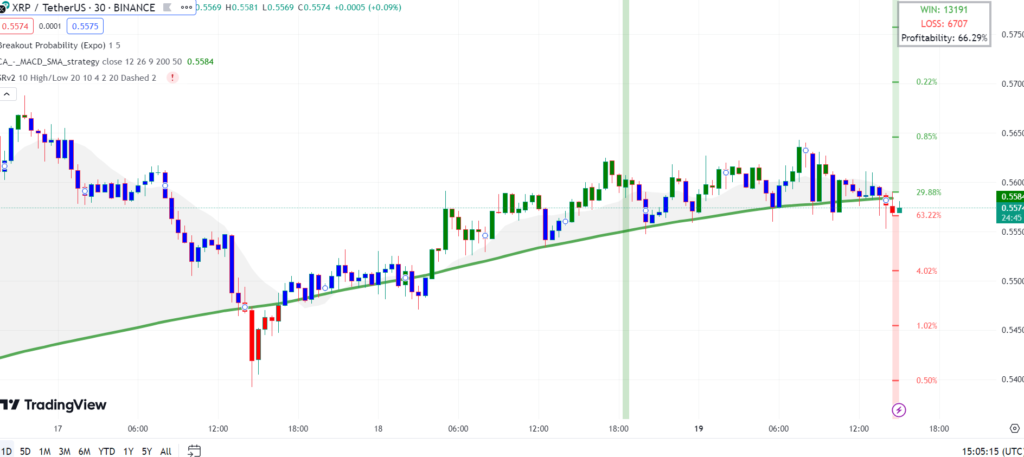
https://www.tradingview.com/chart/2Juxf9yF/?symbol=BINANCE%3AXRPUSDT
🟢 Clave: XRP se diseñó para pagos cross-border con liquidación en 3-5 segundos y costo por transacción de USD $0.0002. Ripple procesa 1.500 TPS comparado con los 15 TPS de Ethereum y los ~7 TPS de Bitcoin, posicionándolo como solución de infraestructura para bancos y proveedores de pagos.
Technical Analysis: XRP Price Action in 2026
XRP’s price action reflects a market that has moved from uncertainty to cautious optimism. After the SEC dropped its appeal, XRP surged from the $0.50-$0.60 range to above $1.00, and has since established a new trading range between $1.20 and $1.60.
Technical indicators paint a nuanced picture:
- Moving Averages: XRP trades above its 50-day and 200-day EMAs, confirming the bullish trend. The 10-day EMA recently crossed above the 50-day EMA — a classic golden cross signal.
- RSI (14): Currently at 62, approaching overbought territory but not yet extreme. This suggests room for further upside before a correction.
- Stochastic %K: At 73, indicating momentum but also suggesting a potential short-term pullback.
- Volume: Trading volume has increased 40% since the SEC settlement news, with average daily volume exceeding $2 billion across major exchanges.
| Indicator | Value | Signal |
|---|---|---|
| Price | $1.44 | Neutral-Bullish |
| 50-day EMA | $1.31 | Bullish (price above) |
| 200-day EMA | $1.08 | Bullish (price above) |
| RSI (14) | 62 | Approaching overbought |
| Support | $1.20 / $1.05 | Key levels |
| Resistance | $1.60 / $2.00 | Near-term targets |
ODL Network: The Engine Powering XRP’s Utility
Ripple’s On-Demand Liquidity (ODL) is the real-world use case that separates XRP from most cryptocurrencies. ODL uses XRP as a bridge currency to enable instant, low-cost cross-border payments without requiring pre-funded nostro accounts.
Here’s how it works in practice:
- Traditional cross-border payment: Bank A in Mexico wants to send $1 million to Bank B in the Philippines. Both banks need to pre-fund accounts in each other’s jurisdictions — tying up capital for days and paying multiple intermediary fees.
- ODL with XRP: Bank A converts pesos to XRP → XRP moves across the blockchain in 3-5 seconds → XRP converts to Philippine pesos. Total cost: a fraction of a cent. Total time: under 10 seconds.
As of 2026, Ripple’s ODL network has expanded significantly:
- 80+ countries with active payment corridors
- 120+ financial institutions using or testing ODL
- Asia Pacific expansion: New corridors in Singapore, Japan, Philippines, and Australia
- Latin America: Bitso processing payments across Mexico, Argentina, Colombia, and Brazil
- Middle East: Partnerships with UAE and Saudi financial institutions
The Cross-Border Payment Revolution
The global cross-border payments market moves over $150 trillion each year, yet it still suffers from inefficiencies that seem from another era: high fees, slow settlement times, opaque pricing, and limited access for underserved populations. Ripple’s vision — and XRP’s fundamental value proposition — is to fix this.
🔵 Contexto: La visión de Ripple es resolver la fragmentación de pagos globales: SWIFT tarda 1-5 días y cobra USD $25-50 por transferencia, mientras que el modelo On-Demand Liquidity (ODL) de Ripple usa XRP como puente para liquidación instantánea, eliminando cuentas prefinanciadas en monedas locales.
| Feature | SWIFT (Traditional) | Ripple ODL (XRP) |
|---|---|---|
| Settlement Time | 1-5 business days | 3-10 seconds |
| Cost | 2-6% | <0.01% |
| Pre-funding Required | Yes (nostro accounts) | No |
| Transparency | Limited | Full (on-chain) |
| Availability | Business hours | 24/7/365 |
| Intermediaries | 2-5 banks | None |
Ripple’s Partnership Ecosystem in 2026
Ripple has been aggressively building partnerships, though the market has not always rewarded these developments with price increases. Key partnerships in 2026 include:
- Bitso (Latin America): The leading digital asset platform in LATAM processes cross-border payments using XRP and RLUSD across Mexico, Argentina, Colombia, and Brazil.
- SBI Holdings (Japan): Long-standing partnership for ODL corridors in Japan and Southeast Asia.
- Tranglo (Southeast Asia): Payment corridors spanning Malaysia, Singapore, Philippines, and Indonesia.
- Santander (Europe): One of the earliest adopters of Ripple’s technology for retail cross-border payments.
- New banking partners in 2026: Multiple financial institutions across the Middle East, Africa, and South America have integrated XRP into their payment infrastructure.
XRP in Latin America: A Strategic Priority
Latin America represents one of the most compelling use cases for XRP and Ripple’s technology. The region receives over $150 billion annually in remittances, with fees averaging 5-7% — a significant burden for families relying on money sent from abroad.
Ripple has made LATAM a strategic priority in 2026:
- Brazil launch: Ripple launched a cross-border payments expansion in Brazil, positioning itself as the only solution in the region capable of serving institutions across the full spectrum of financial needs — from cross-border payments to digital asset custody.
- Bitso integration: Bitso, Latin America’s largest crypto exchange by volume, has fully integrated XRP, RLUSD, and Ripple Payments to streamline cross-border transactions for businesses.
- Pilot programs: Ripple is conducting pilot tests with banks in Colombia, Argentina, and Mexico for direct ODL integration.
XRP Price Predictions: Bull vs. Bear Scenarios
| Scenario | Price Target | Key Catalysts |
|---|---|---|
| Bearish | $0.80-$1.20 | Macro downturn, low ODL volume, regulatory setbacks |
| Base Case | $1.50-$2.50 | Steady ODL growth, CLARITY Act passage, continued partnership expansion |
| Bullish | $3.00-$5.00 | Major bank adoption, ETF approval, favorable macro environment |
| Ultra-Bullish | $10+ | XRP ETF launch, massive institutional inflows, SWIFT replacement narrative |
🎯 Author’s Perspective
After 8 years in the crypto space, I’ve watched XRP go through more narrative shifts than almost any other asset. It’s been called a bank coin, a security, a utility token, and everything in between. What hasn’t changed is Ripple’s actual business: building payment infrastructure that works.
The SEC lawsuit was the best and worst thing that happened to XRP. Worst because it suppressed the price for nearly five years and created massive uncertainty. Best because it forced Ripple to prove, in court, that XRP is not a security — a distinction that now benefits the entire industry.
My view for 2026: XRP’s value will ultimately be determined not by partnerships or legal victories, but by transaction volume through ODL. If financial institutions actually use XRP for cross-border payments at scale, the price will reflect that utility. If partnerships remain mostly pilot programs and press releases, XRP will trade on sentiment rather than fundamentals. Watch the data, not the headlines.
🟡 Atención: La correlación entre adopción institucional de ODL y el precio de XRP no es directa: Ripple puede escalar volumen sin que el precio de XRP se mueva proporcionalmente. Los inversores que compran XRP esperando que cada partnership se traduzca en apreciación están ignorando la dinámica real de la utilidad del token.
❓ Frequently Asked Questions
Is the SEC lawsuit against Ripple completely over?
Effectively yes. The SEC dropped its appeal in 2025, and Ripple dropped its cross-appeal in 2025-2026. While there may be procedural steps remaining (like the $125 million penalty resolution), the legal risk that kept XRP’s price suppressed for years is now largely behind us. [Fuente: Reuters, DL News]
What is ODL and why does it matter for XRP’s price?
ODL (On-Demand Liquidity) is Ripple’s product that uses XRP as a bridge asset for cross-border payments. It matters because it creates actual demand for XRP — not speculative demand, but utility demand. When a bank uses ODL to send $10 million from Mexico to the Philippines, it buys XRP, transfers it, and sells it — creating real transaction volume. The more ODL volume grows, the more fundamental support XRP’s price should have.
Can XRP reach $10?
It’s possible but requires extraordinary conditions. At $10, XRP’s market cap would be approximately $500 billion — roughly the size of Johnson & Johnson or Procter & Gamble. This would require massive ODL adoption, potentially an XRP ETF, and a favorable macro environment. Coincub and other analysts have explored this scenario, but it remains a long-term bullish case, not a near-term expectation.
How does RLUSD affect XRP?
RLUSD is Ripple’s USD-backed stablecoin launched in late 2024. It complements rather than competes with XRP. RLUSD is used for domestic and intra-corridor payments where a stable value is preferred, while XRP serves as the bridge asset for cross-currency conversions. Both products strengthen Ripple’s ecosystem and create more reasons for institutions to use the platform.
Why hasn’t XRP’s price reacted to partnership announcements?
Markets are forward-looking and price in expected developments. By 2026, the market has come to expect regular partnership announcements from Ripple, so individual announcements no longer move the price. What would move the price is evidence of actual transaction volume growth, major bank adoption at scale, or regulatory catalysts like an XRP ETF approval.
Is XRP a good investment for Latin American investors?
This depends entirely on your risk tolerance and investment horizon. XRP has a real-world use case (cross-border payments) that differentiates it from many cryptocurrencies. However, it’s still a volatile asset in an unpredictable market. The SEC resolution removes a major overhang, but macroeconomic factors and competition from CBDCs and other payment solutions present ongoing risks. Never invest more than you can afford to lose.
What’s the difference between Ripple the company and XRP the token?
Ripple is a private company that builds payment infrastructure and software products. XRP is the digital asset that powers some of those products (specifically ODL). Ripple holds a significant amount of XRP (in escrow, released gradually), which creates a relationship between the two but they are not the same thing. Ripple’s success does not automatically translate to XRP’s price appreciation, though they are correlated.
🔴 Riesgo: El mayor riesgo para XRP es regulatorio: aunque el caso SEC vs Ripple concluyó favorablemente en 2023, nuevas regulaciones sobre clasificación de tokens, stablecoins competidoras (CBDCs), y la posible exclusión de XRP de mercados por jurisdicciones específicas podrían limitar severamente su adopción.
How does the CLARITY Act affect XRP?
The CLARITY Act (Crypto Legislative and Regulatory Innovation for Tomorrow’s Yield) is progressing through the US Congress in 2026. It would establish clear frameworks for classifying digital assets as securities or commodities. Given that XRP has already been ruled not a security, the CLARITY Act would reinforce this status and potentially open the door for XRP-based financial products (like ETFs) that were previously impossible under regulatory uncertainty.
📚 Sources & Verification
- Reuters — “Ripple to drop cross appeal against US SEC in crypto lawsuit, CEO says”, June 2025. reuters.com
- DL News — “Ripple drops appeal to close the chapter on SEC suit, XRP price higher”, 2026. dlnews.com
- OpenPR — “XRP Price Prediction: Ripple Cross Border ODL Network Expands”, 2026. openpr.com
- Capital.com — “Ripple price prediction: CLARITY Act Progress, SEC Roundtable”, April 2026. capital.com
- StealthEX — “How XRP Is Changing Cross-Border Payments: 2026 Guide”, 2026. stealthex.io
- Ripple — Bitso Customer Case Study, 2026. ripple.com
- Yahoo Finance — “Every Ripple Partnership in 2026 Has Failed to Move XRP Price”, 2026. finance.yahoo.com
- BYDFi — “SEC vs XRP 2026: Market Impact & Future Outlook Guide”, 2026. bydfi.com
Last verified: May 4, 2026
🔗 Related Articles
- Ripple (XRP) — Complete Guide
- Ripple SEC: Detalles de la Apelación
- Las Mejores Aplicaciones de Trading
- Guía para Comprar Criptomonedas
- Pronósticos de Criptomonedas
⚠️ Disclaimer: This article is for informational and educational purposes only. It does not constitute financial, legal, or investment advice. Cryptocurrencies are high-risk assets and their value can fluctuate significantly. Before investing, consult with a qualified financial advisor and read our Editorial Standards. For more information about our team and methodology, visit About Blockchain.cl.
✍️ Author: Cristian Fuentes — Co-founder of Blockchain.cl, financial markets psychologist with 8+ years of experience in cryptocurrencies and blockchain.

🔹 Psicólogo de Mercados Financieros
🔹 Inversor Crypto desde 2017 (8+ años de experiencia)
🔹 Ex-Analista de Riesgos Financieros
🔹 Speaker en Conferencias Crypto LATAM
🔹 Formación: Psicología (Universidad San Sebastián) + Finanzas Conductuales
📍 Ubicación: Concepción, Chile
📧 Contacto: [email protected]
💡 Filosofía: "Las criptomonedas no son solo tecnología—son psicología, economía y sociología combinadas. Entender el comportamiento humano es clave para navegar este espacio."
⚠️ Disclaimer: El contenido de Blockchain.cl es informativo y educativo. NO es consejo financiero, de inversión o legal. Haz tu propia investigación (DYOR) antes de tomar decisiones financieras.
📊 Holdings Crypto Personales (Declarados Transparentemente):
• Bitcoin (BTC): 65% - Hold desde 2017
• Ethereum (ETH): 20% - Hold desde 2018
• Stablecoins (USDC, DAI): 10%
• Altcoins (SOL, AVAX, MATIC, DOT): 5%
🔒 Conflictos de Interés: No tengo posiciones significativas (>1% del portfolio) en proyectos que cubro activamente. Si escribo sobre un proyecto donde tengo holdings menores, lo declaro al final del artículo.
- Binance vs Coinbase 2026: Comparativa Exhaustiva de Comisiones, Seguridad y Características - 4 de Septiembre de 2026
- Impuestos sobre Bitcoin y Criptomonedas en España 2026: Guía Completa de Tributación - 4 de Septiembre de 2026
- Las 7 Mejores Wallets de Bitcoin en 2026: Guía Completa de Almacenamiento Seguro - 4 de Septiembre de 2026